Note (December 8th): This is a revamp of the post ‘Don’t Worry, Be Hampi’ I published last August.
Prior to arriving in Kunming, I spent a month in India with three friends. It had its ups and downs, but my five-day visit to the little-known village of Hampi was the highlight of the trip. I arrived on a night train from Hyderabad on August 1, 2015.
Hampi is located almost directly between Hyderabad, Goa, and Bangaluru, in the southwest Indian state of Karnataka. In the sixteenth century, Hampi was the capital of the Vijayanagara Empire. Formed and unified in opposition to the Muslim kingdoms of the north, Vijayanagara was established as a Hindu kingdom. The empire’s then-need for an army of one million soldiers illustrates the simmering tensions between India’s north and south at the time.

Five hundred years ago, Hampi’s population of 500,000 made it the second largest city in the world after Beijing. Being the center of such a focused religious culture, the monuments, temples, and structures in the ancient city are singular to the rest of the world. Today, the area is a UNESCO World Heritage Site, frequented by adventuresome backpackers, and littered with ancient ruins and magnificent vistas.
Arriving on time to Hospet Junction, the local train station, we took a rickshaw to the Hampi pier. The Tungabhadra River divides the village in half, and the only way to cross it is by boat. The men in charge of the ferry presented us with three options: wait for enough people to fill the boat, pay 100 rupees (US$1.50) per person to leave immediately, or pay 50 rupees each to ride a raft which resembled an outsized half-coconut.

We chose the last option. The raft had a hole in it and was taking on water, but it was an appealing — or at least, adventurous — choice in the moment. So we went for it. By the time we took off, there were four tourists with large bags, the boatman, his friend and two eleven year-old kids in the raft. It took awhile, but we did eventually make it to the other side, albeit quite drenched.
On the first afternoon in Hampi, our host Murali set us up with motorbikes. I had never ridden one before, but Murali said “Good luck!”, and off we went. Using a makeshift map, we navigated ten kilometers to the only nearby small town that had a petrol station and ATM. The ride there was fascinating, as it revealed a way of Indian life starkly different from the congested cities through which we had already travelled.

Gone were the poverty and dead dogs of Delhi, replaced with vast rice paddies, a wildly varying landscape of mountains and plains, as well only brief stretches of settlement. This is what I had hoped to see from the Subcontinent. Within the first 30 seconds of the ride, we passed an ancient and long-dry stone aqueduct seemingly more than 1,000 years-old.
The next day, I left my friends and took off on my own adventure. First heading northwest, I spent an hour sitting along the edge of Sanapur Lake. Murali’s map made it look obvious how to get from the lake back to civilization. It was not. Heading in the right general direction, and knowing I wasn’t going to find the exact route, I just drove along a canal to see where I would eventually end up.

As it turned out, I followed the canal road through quarries, farms, past stray temples, minuscule villages, and took the road through tight pathways and wide-open landscapes. At one huge rice paddy, I could see a number of locals coming home after a long day’s work. As they made it up to the road, I asked for directions. Helpfully, they flagged down a local man on a motorcycle, who guided me through a couple of villages, then pointed the rest of the way back to Hampi. Just as I about to make it back, a monsoon storm hit, forcing me to take refuge with two old women underneath a sheetmetal structure.
Before dinner that night, my friends and I caravanned to a local temple. Perched on top of Hemakuta Hill, we climbed what seemed like 6,000 steps to see a landscape view replete with sunset. The wind was howling at that elevation, but the vista was nothing short of incredible.

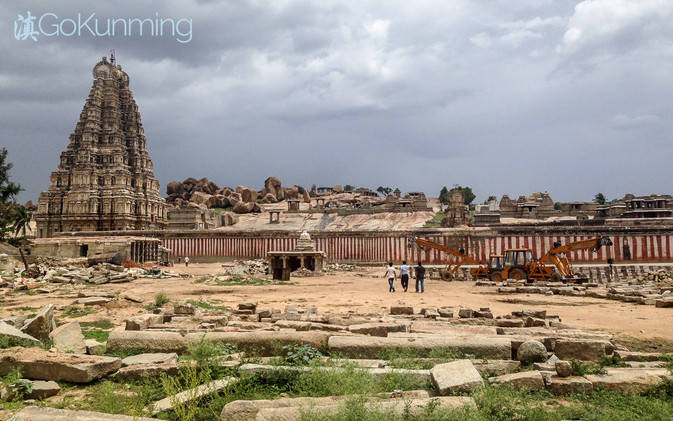
On my last full day in Hampi, it was finally time to cross the river again and investigate the ruins for which the area is known. Turns out, the temples and ruins have become commercialized the extent one would expect from UNESCO status. In a similar vein to Lijiang and Angkor Wat, this ruined the mystique somewhat, to the point that the place was not nearly at engaging as it should have been. That said, the structures themselves look amazing from the outside. Virupaksha Temple, especially, was an architectural marvel. The intricate stonework and engravings, along with the edifice’s sheer size, made the surrounding locales pale in comparison. We ended up spending the rest of the time exploring that side of town, getting lunch while taking cover from another monsoon rain or two.
On the morning of our departure, we once again rode the half-coconut shell raft across the river to get back to the train depot. It was simply too early in the morning for the boat to safely navigate the crossing. We caught our train just in time, and successfully made it to Goa later that day. A week later, I arrived in Kunming. Now, months later, Hampi still stands out as the high point of my journey towards Kunming.

Images: Jordan Steinberg
Original GoKunming Article: http://tinyurl.com/gn6ljfy
 JAWS Going Places