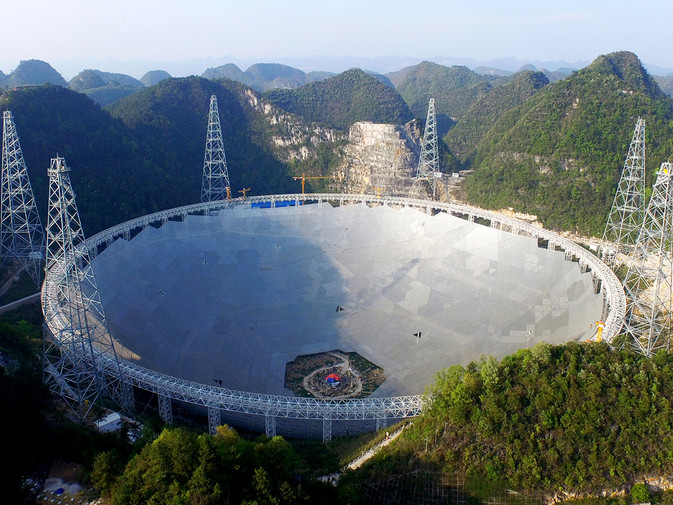
In a country where bigger often equates to better, a truly massive science project is about to go online in Guizhou. Approximately 170 kilometers southeast of the provincial capital Guiyang, within a Karst depression in Pingtang County (平塘县), construction is nearing completion on the world’s largest radio telescope. At 500 meters in diameter, the telescope, which has been dubbed the ‘Five-hundred-meter Aperture Spherical Telescope’, or FAST for short, dwarfs all predecessors. In Puerto Rico, the 53 year-old Aceribo Telescope comes in next at 305 meters.
In this case, such gargantuan size works to the project’s benefit. Radio telescopes, as opposed to standard optical variants, rely on the absorption of radio waves to gather data. This is similar to how ears take in information versus eyes. As such, the bigger the radio telescope, the greater its volume of input, and thus the higher potential for discovery.
This helps explain why Guizhou was chosen. With an average of only 1,150 sunshine hours per year, Guizhou is the least sunny region of China. While an optical telescope would be laughably inadequate for such conditions, it is perfect for radio telescopes, which do not require clear skies to listen to the universe. Guizhou’s fairly sparse population and stable Karst topography were other major considerations.

Heading the 700 million yuan (US$106 million) project is Professor Nan Rendong of the National Astronomical Observatories at the Chinese Academy of Sciences. He envisions several important tasks for the telescope — which is made up of 4,600 triangular sensor panels — once it goes into operation in September. With its immense size, FAST is expected to be able to ‘listen’ to previously unstudied parts of the universe at distances of hundreds of millions of light years.
First and foremost among these will be the search for an understanding of the nascent universe, particularly as it relates to ancient traces of hydrogen. The second priority will focus on the research of pulsating radio star, which emit enormous, and potentially destructive, amounts of radiation. Lastly, the development team headed by Nan hopes that the telescope will become a crucial component in the search for extraterrestrial life.
Such experiments are not without a human cost, however. In order to construct the telescope, the village of Daowodang was summarily demolished, and its residents relocated. Unfortunately, radio telescopes, especially ones of such colossal size, are extremely sensitive to interference. As such, every additional village within a five kilometer radius of the project site has been subject to a mandatory ‘radio quiet zone’. This means no wireless networks, no cell phones or any other technological item that has the potential to interfere with the telescope’s data gathering.
Resulting reports indicate that an estimated 9,000 villagers have been affected by the regulations. In response, Professor Nan has stressed the telescope’s long-term potential, saying, “It will attract a lot of scientists and tourists, and it’s also a very good model for education, for the next generation, and for Chinese industry”.
Top image: Astronomy Now
Bottom image: CNN
Original GoKunming Article: http://tinyurl.com/zswnu7d
 JAWS Going Places